
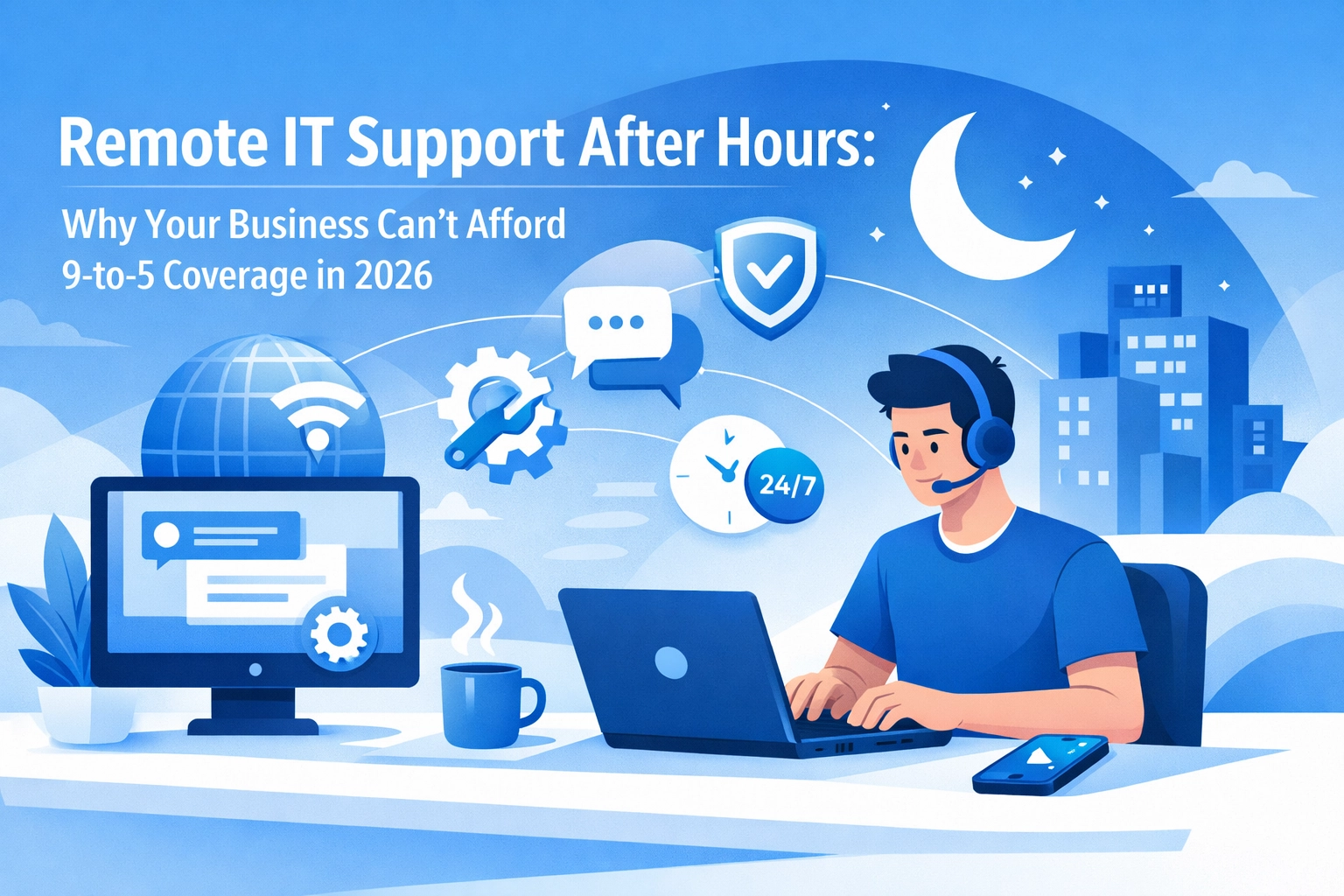
Let's be honest , the idea that IT problems only happen between 9 and 5 is about as realistic as expecting your car to only break down during garage opening hours. Yet plenty of businesses still operate with IT support that clocks off at 5pm and vanishes until Monday morning.
In 2026, that approach isn't just inconvenient. It's genuinely risky.
We're not talking about minor annoyances here. When your systems go down at 11pm on a Saturday, and your team can't access critical files for a Monday morning presentation, that's not just frustrating , it's potentially business-ending. Let's dig into why after-hours remote IT support has shifted from "nice to have" to "absolutely essential."
When Problems Don't Keep Business Hours
Technical issues have never been particularly considerate about timing. Servers don't check the calendar before crashing. Cyberattacks don't wait for your IT manager to finish their morning coffee.
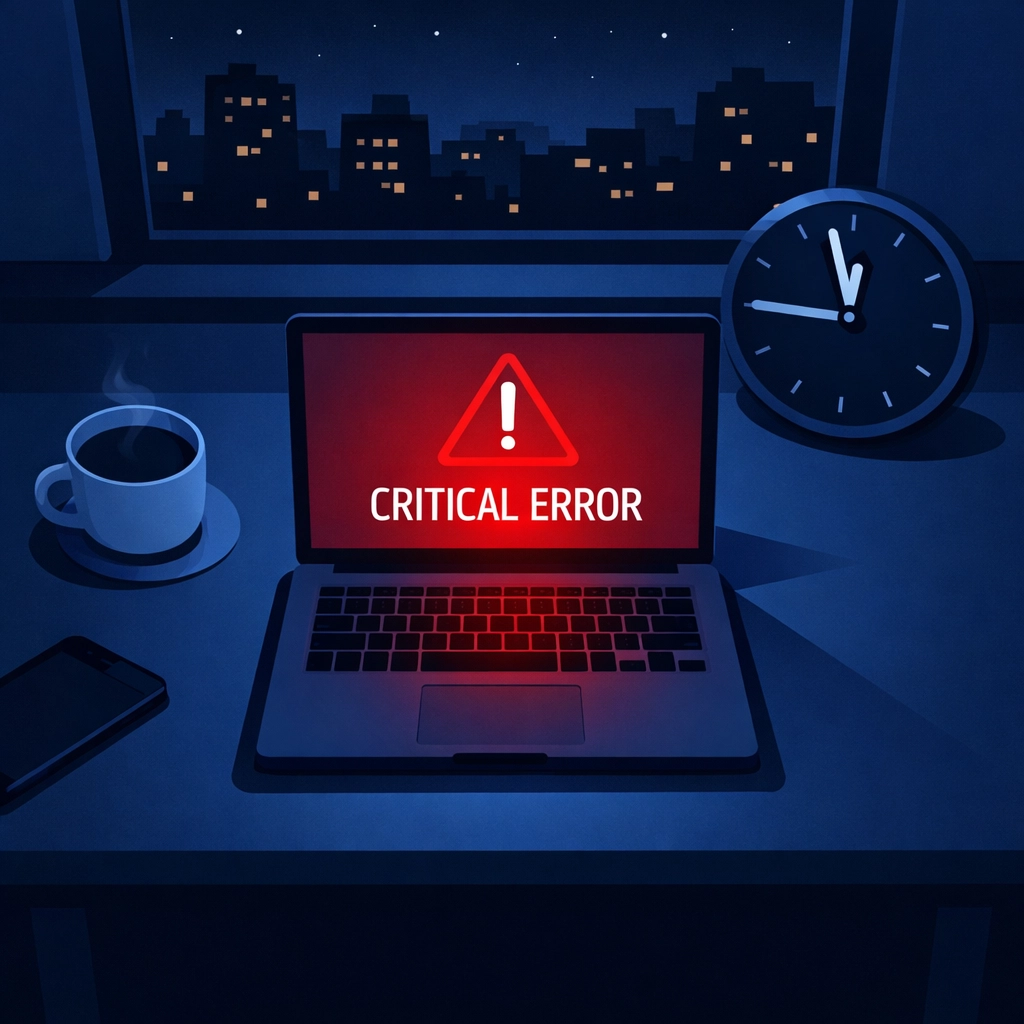
The reality we're seeing in 2026 is that downtime costs have skyrocketed. Every hour your systems are offline, you're bleeding productivity and revenue. If that hour happens at 2am and there's nobody available to fix it until 9am, you've lost seven hours before anyone even starts looking at the problem.
We've watched businesses lose thousands in a single evening because their payment processing went down during peak online shopping hours. The fix? Five minutes of work. But those five minutes didn't happen until the next business day, and by then, customers had already moved on to competitors.
Remote IT support that operates outside standard hours means issues get addressed when they happen, not when it's convenient for your support provider's schedule. It's the difference between a minor inconvenience and a major crisis.
Your Team Doesn't Work 9-to-5 Anymore (Why Should Your IT Support?)
Here's something that's fundamentally changed since the pandemic shook everything up: the traditional 40-hour work week is increasingly rare. Your team might include someone starting at 6am, another finishing at 10pm, and a developer working from three time zones away.

If Sarah in accounts can't log into the system at 7pm when she's trying to close the month's books, she can't just "wait until tomorrow." That deadline doesn't move. If Mark's laptop won't connect to the VPN at midnight because he's working with clients in Australia, he needs help now, not in nine hours.
This isn't about being demanding. It's about matching IT support to how businesses actually operate in 2026. Remote work hasn't just changed where we work , it's completely restructured when we work. Your IT infrastructure needs to reflect that reality.
After-hours remote IT support ensures that every member of your team, regardless of when or where they're working, has access to technical assistance. It levels the playing field and removes the productivity penalties that come with flexible working arrangements.
Cybercriminals Work Weekends (And Nights, And Holidays)
Let's talk about something slightly less comfortable: security threats don't take time off.
In fact, many cyberattacks are specifically timed for weekends and evenings when they're less likely to be immediately detected. Hackers know that most businesses have reduced monitoring outside business hours. They're counting on it.
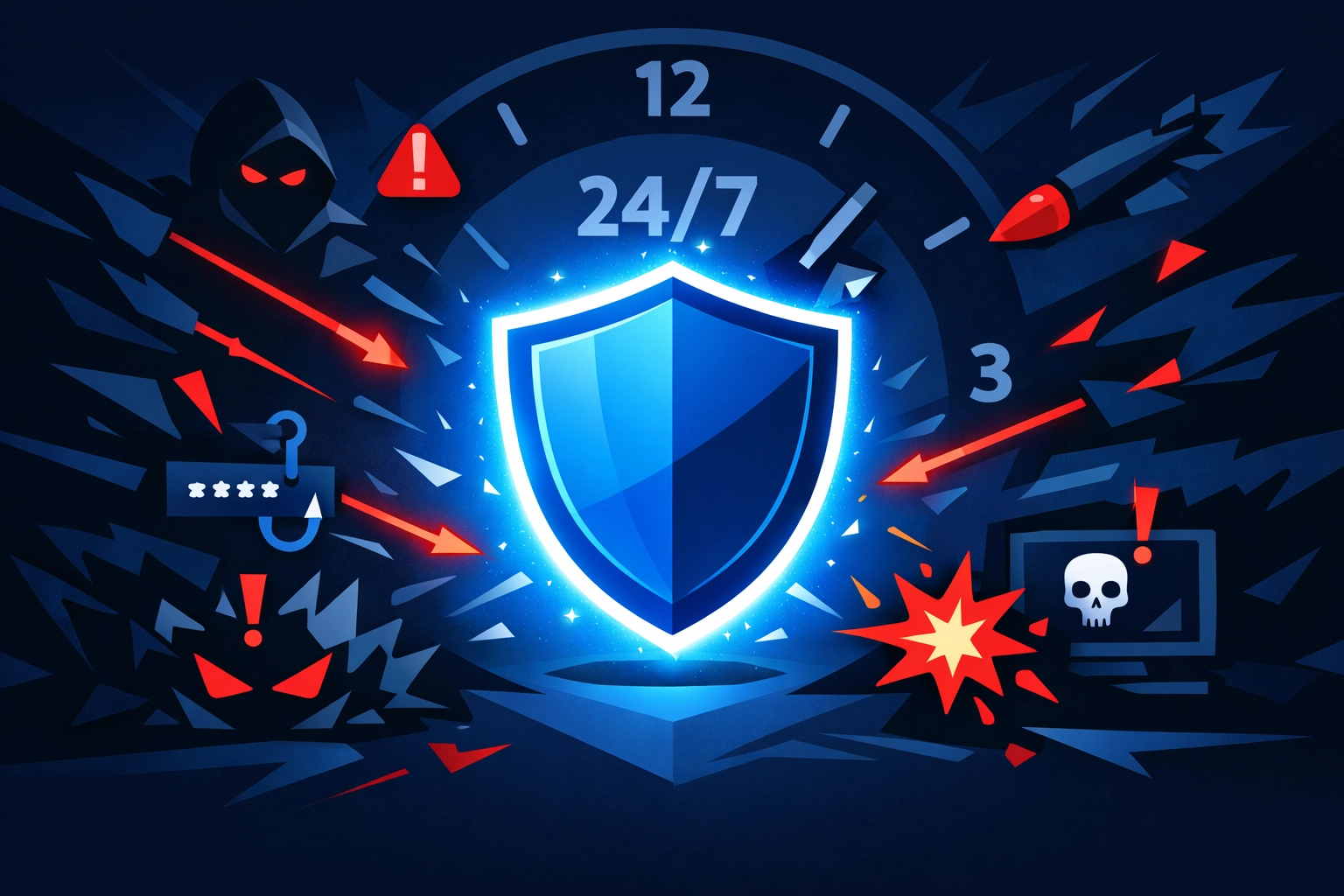
A ransomware attack that starts at 11pm Friday night and isn't discovered until Monday morning has given attackers a 60-hour head start to encrypt your data, exfiltrate sensitive information, and establish persistent access to your systems. That's not a scenario we want to find ourselves in.
Continuous monitoring and immediate incident response aren't luxuries anymore , they're baseline requirements for any business that takes data security seriously. When suspicious activity is detected at 3am, waiting six hours to investigate isn't acceptable. By then, the damage is done.
After-hours remote IT support provides that continuous watchfulness. Systems can be monitored, threats can be identified, and responses can be initiated immediately, regardless of what time the clock shows.
The Economics Actually Make Sense
Right, let's address the elephant in the room: surely 24/7 coverage must be prohibitively expensive?
Actually, no. Not if you approach it sensibly.
Maintaining an in-house team to provide round-the-clock coverage would indeed be eye-wateringly expensive. You'd need multiple shifts, specialized staff for different areas, and enough redundancy to cover holidays and sick leave. For most businesses, that's completely unrealistic.
But outsourced remote IT support changes the economics entirely. Managed service providers can offer after-hours coverage at a fraction of what it would cost to build internally, because they're spreading that cost across multiple clients. They've already got the infrastructure, the processes, and the personnel in place.

What you're paying for is access to that existing capability, not funding its entire creation. It's the same principle as why renting a van for moving house makes more sense than buying one you'll use once.
At Your IT Specialist, we've built our entire service model around providing that out-of-hours support without the premium price tag typically associated with 24/7 coverage. It's one of the reasons we exist : because businesses need this capability, but they need it to be affordable and sustainable.
How After-Hours Support Actually Works
There's sometimes a misconception that after-hours IT support means dealing with skeleton crews or junior staff who can't really help with complex issues. That's not how it should work.
Proper after-hours remote IT support should provide the same quality and expertise as daytime support. The person helping you at 10pm should be just as capable as the person who'd help you at 10am.
The remote aspect is crucial here. Because support is delivered remotely, geographical constraints disappear. Your support team doesn't need to be in the same city, or even the same country. They just need secure access to your systems and the expertise to solve your problems.
This also means we can provide genuine 24/7 coverage without anyone working unreasonable hours. Different team members cover different shifts, and because we're provider-agnostic, we can work with whatever systems and platforms you're using. We're not trying to sell you specific solutions : we're focused on keeping your existing setup running smoothly.
What This Means For Your Business
The shift to expecting after-hours IT support availability isn't about being demanding or unreasonable. It's about acknowledging that business continuity in 2026 requires IT support that matches how modern businesses actually operate.
If you're currently limited to business-hours support, we'd recommend having a conversation about what happens when (not if) something goes wrong outside those hours. Who responds? How quickly? What's the escalation process?
These aren't theoretical questions. At some point, probably sooner than you'd like, you'll face a technical issue that can't wait until Monday morning. Having a plan for that scenario is just sensible business continuity planning.
For MSPs reading this, there's another angle worth considering: offering after-hours support can be a genuine differentiator in a crowded market. Many of your competitors won't want the complexity of managing 24/7 coverage. If you can solve that problem, either through your own expanded team or through whitelabel partnerships, you've got a compelling advantage.
Moving Forward
The businesses thriving in 2026 aren't necessarily the ones with the biggest IT budgets. They're the ones who've matched their IT support model to their actual operational needs.
If your business operates beyond standard hours, serves customers in multiple time zones, or relies on always-available systems, then 9-to-5 IT support is creating unnecessary risk. The good news? Solving this doesn't require radical changes or enormous investment.
It requires partnering with an IT support provider who understands that protecting your business means being available when you need them, not just when it's convenient for their schedule. That's not revolutionary : it's just realistic about how businesses work in 2026.
We've built our service specifically around this need, providing out-of-hours remote IT support that businesses can actually afford and rely on. Because ultimately, peace of mind shouldn't be a luxury reserved for enterprises with unlimited budgets. It should be accessible to any business that needs it.
Your systems are running 24/7. Your support probably should be too.
