
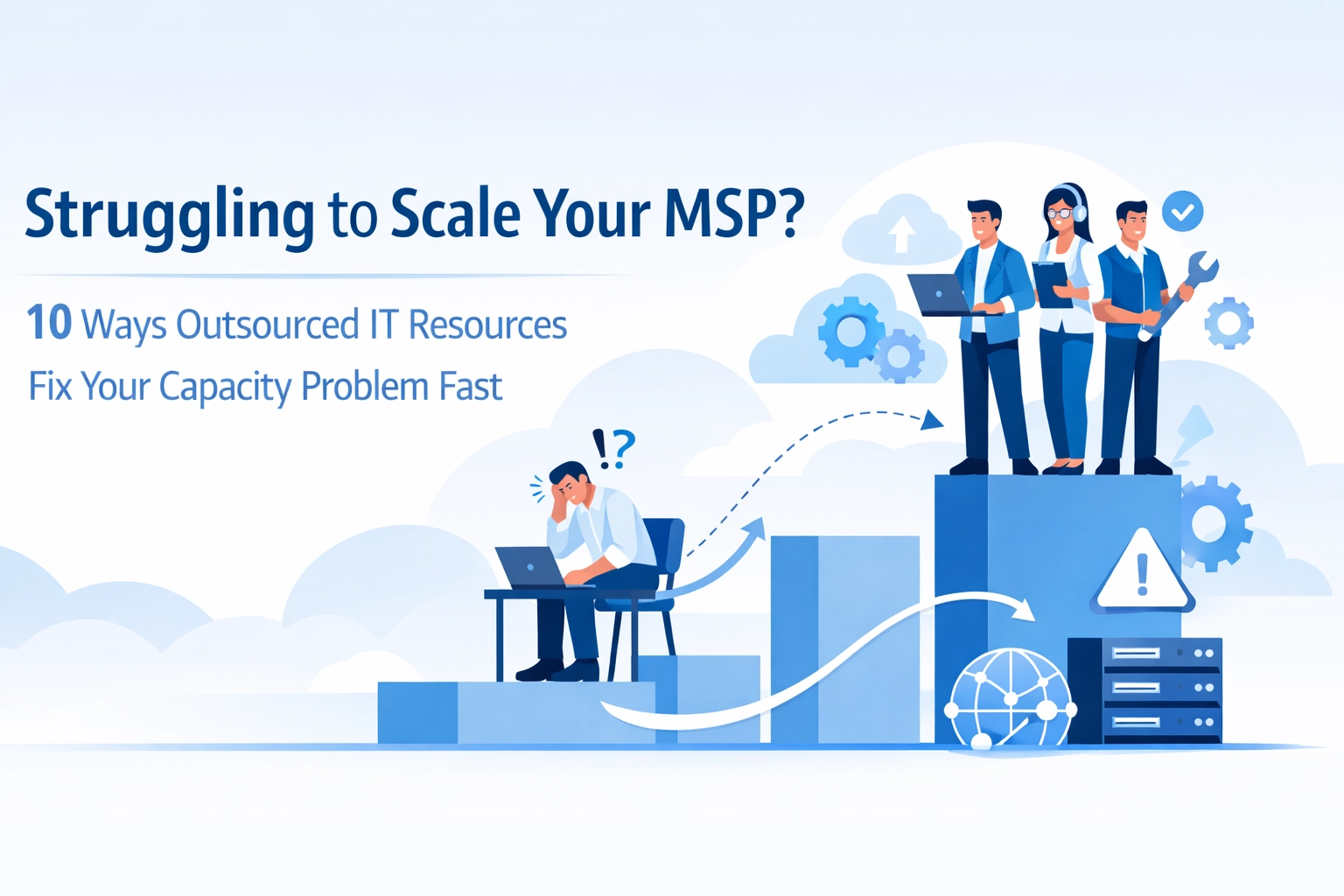
We've all been there. Your MSP is growing, clients are happy, and then suddenly you're drowning in tickets. Your team's working overtime, response times are slipping, and you're turning away new business because you simply don't have the hands on deck.
The capacity crunch hits every MSP eventually. The question isn't if, but when: and more importantly, how you'll handle it.
Here's the thing: hiring full-time staff takes months. Recruitment, onboarding, training: it's a massive investment. And what happens if that growth spike was temporary? You're stuck with overhead you can't sustain.
That's where outsourced IT resources come in. Not as a replacement for your team, but as a strategic extension of it. Let's look at 10 practical ways outsourcing fixes your capacity problem without the headaches of traditional hiring.

1. Handle Overflow Tickets When Demand Spikes
Some weeks you're cruising. Other weeks, everyone seems to need help at once. Outsourced support teams can absorb those overflow tickets immediately, keeping your SLAs intact while your core team focuses on complex issues.
We're not talking about shipping everything offshore. We're talking about smart capacity planning: having backup when you need it, without carrying extra staff when you don't.
2. Cover Out-of-Hours Support Without Burning Out Your Team
24/7 support sounds great on your sales deck. Actually delivering it? That's another story.
Running a night shift with internal staff is expensive and exhausting. Outsourced resources operating in different time zones can handle after-hours tickets seamlessly. Your clients get round-the-clock coverage, and your team gets to sleep.
It's worth noting that out-of-hours service isn't just a nice-to-have anymore: it's often the difference between landing that enterprise client or losing them to a competitor.

3. Fill Specialist Skill Gaps Instantly
Need someone who speaks fluent Azure? Or a security specialist for compliance projects? Hiring for niche skills is tough: and expensive.
Outsourced IT resources give us access to specialists without the commitment. Need VMware expertise for a migration? Done. Cloud architect for three months? Sorted. When the project wraps, so does the expense.
4. Keep Projects Moving While Maintaining Business as Usual
Here's a classic scenario: you land a big migration project, but your team's already handling daily support. Something's got to give.
Outsourced resources let us run projects in parallel with BAU support. One team handles the day-to-day tickets while another tackles that infrastructure overhaul. No corners cut, no delays, no burned-out technicians.
5. Scale Up (or Down) Based on Actual Demand
Traditional staffing is binary: someone's either employed or they're not. Outsourcing gives us a volume dial instead of an on-off switch.
Landed a major new client? Ramp up support coverage immediately. Lost a contract? Scale back without redundancies. This flexibility is massive for cash flow and planning.

6. Reduce Burnout and Turnover in Your Core Team
Constantly running at 110% capacity isn't sustainable. Burnout leads to mistakes, which leads to unhappy clients, which leads to losing staff: or worse, losing customers.
Outsourced resources take pressure off your core team. Your technicians can focus on high-value work instead of drowning in password resets and basic troubleshooting. Happy team, better retention, higher quality work.
7. Eliminate Hiring Delays and Recruitment Risks
The average IT hire takes 3-6 months from job posting to productive team member. In MSP terms, that's an eternity.
Outsourced IT resources are ready to go: often within days, not months. No recruitment fees, no onboarding overhead, no risk of a bad cultural fit. If someone isn't working out, you can adjust quickly without HR nightmares.
8. Expand Geographic Coverage Without Physical Offices
Want to service clients in different regions but can't justify opening satellite offices? Outsourced teams can provide local support coverage without the infrastructure investment.
This isn't about call centres reading scripts. We're talking about skilled technicians who can handle real technical issues, just operating from different locations. Your clients get better coverage, you avoid massive overhead.

9. Maintain Service Levels During Holidays and Sick Leave
Staff holidays and unexpected illness can wreck your capacity planning. When two technicians are off the same week, suddenly everyone else is scrambling.
Outsourced resources provide consistent coverage regardless of your internal team's availability. No more begging people to cancel holidays or come in sick. Your service levels stay solid year-round.
10. Get Cost Predictability Without Full-Time Overheads
Full-time employees come with hidden costs: pensions, equipment, office space, training, benefits. These add 30-50% on top of base salary.
Outsourced IT resources give us predictable, transparent costs. We pay for what we need, when we need it. No surprise expenses, no long-term liabilities if things slow down. That predictability makes financial planning so much easier.
Making Outsourced IT Resources Work for Your MSP
Here's what we've learned: outsourcing isn't about replacing your team or going cheap. It's about strategic capacity management.
The best MSPs use outsourced resources as a flexible extension of their core team. They handle volume, cover gaps, and provide expertise when needed: without the commitment and overhead of traditional hiring.

Think of it like cloud infrastructure. We wouldn't run our own data centres when we can leverage AWS or Azure for flexibility and scale. The same principle applies to human resources.
What to Look For in Outsourced IT Partners
Not all outsourced providers are created equal. When we're evaluating partners, we focus on:
- Technical competence – Can they actually solve problems, or just log tickets?
- Communication skills – Will your clients even notice they're talking to an external resource?
- Flexibility – Can they scale with your needs, or are you locked into rigid contracts?
- Cultural fit – Do they align with how you do business?
- Transparency – Are costs and processes clear, or full of hidden surprises?
Provider-agnostic advice matters here too. The right partner should recommend what genuinely works for your situation, not just what's easiest for them to deliver.
The Bottom Line
Capacity problems kill MSPs. Not immediately: it's death by a thousand missed SLAs, burned-out staff, and opportunities we had to turn down.
Outsourced IT resources aren't the only solution, but they're one of the fastest and most flexible. They let us grow smart instead of growing painful.
The MSPs winning right now aren't necessarily the biggest: they're the ones who've figured out how to deliver consistent, quality service regardless of demand fluctuations. Outsourcing is a big part of that equation.
We can't control when capacity crunches hit. But we can control how we respond to them. Having the right outsourced partners in place means we're ready when opportunity knocks: instead of scrambling to figure out how we'll deliver.
If you're struggling with capacity, it might be time to explore how outsourced IT resources could work for your MSP. The alternative: continuing to stretch your team thin: isn't sustainable. Trust us, we've seen how that story ends.
