
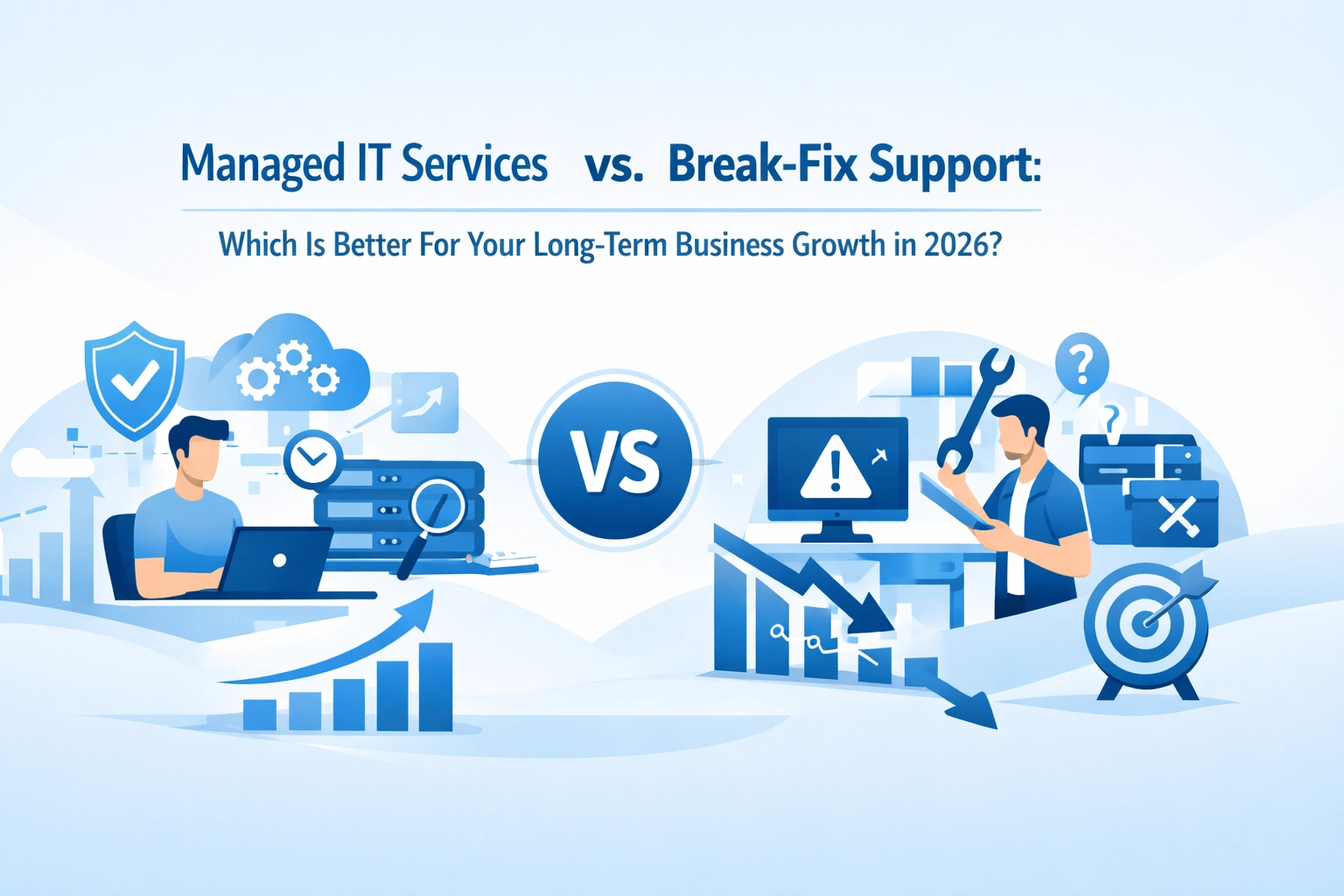
Let's get straight to it: if you're planning to grow your business in 2026 and beyond, managed IT services will serve you better than break-fix support. It's not even close.
We've seen countless businesses make the switch after realizing that paying per problem just doesn't scale. But before we dive into why managed services wins, let's make sure we're all on the same page about what we're comparing.
What's the Actual Difference?
Break-fix support is exactly what it sounds like. Something breaks, you call someone, they fix it, you pay for that specific fix. It's reactive, unpredictable, and honestly, it's how most businesses start out.
Managed IT services flip the script. You pay a fixed monthly fee, and your IT partner monitors everything proactively, handles updates, manages security, and yes: fixes things when they break. But more importantly, they work to prevent breaks in the first place.

The Break-Fix Model: Why It Feels Cheaper (But Isn't)
When you're running a small operation: maybe five employees, basic tech needs: break-fix seems sensible. You're only paying when something goes wrong, right?
Here's where it gets tricky. Break-fix creates a weird incentive problem. The technician makes money when you have problems. They're not incentivized to make your systems more reliable or advise you on preventative measures. We're not saying they're deliberately creating issues (most aren't), but the business model doesn't reward problem prevention.
Plus, when something does break, you're stuck waiting. No guaranteed response time. No SLA. Your email server's down? Get in the queue. Your team can't access critical files? Hope someone's available today.
For tiny operations spending £1,000-£3,000 annually on IT, break-fix can work. But the moment you hit around 10 users, the math changes dramatically.
Managed IT Services: The Long Game
With managed services, we're talking about a partnership rather than a transaction. Your IT provider succeeds when your systems run smoothly: their incentives actually align with yours.
What you get typically includes:
- 24/7 monitoring that catches issues before they impact your team
- Proactive maintenance including updates, patches, and optimization
- Guaranteed response times through proper SLAs
- Strategic planning to align your tech with your growth plans
- Security management that's continuous, not reactive
The monthly cost is predictable. No surprise invoices. No emergency rates. No budgeting headaches trying to guess what might break next quarter.

Let's Talk Real Numbers
Research shows businesses working with managed service providers cut their annual IT costs by at least 24%, with another third saving between 25% and 49%. That's not small change.
But the savings aren't just direct costs. Think about downtime. When your systems go down with break-fix support, you're paying for:
- Lost productivity (your team literally can't work)
- Delayed projects and missed deadlines
- Customer frustration and potential lost business
- Emergency technician rates
- Extended diagnosis and repair time
Managed services minimize these hidden costs through proactive monitoring. Issues get caught and resolved before they cascade into full outages.
We've seen businesses hesitate because the monthly fee feels higher than their occasional break-fix invoices. Then they track their actual costs over a year: including downtime and lost opportunities: and realize they're already spending more than managed services would cost.
Scalability: Where Break-Fix Falls Apart
Here's where it gets really clear. As you grow, break-fix becomes progressively worse.
Add more users? More potential problems. More complexity. More systems that need support. Your break-fix costs don't scale linearly: they accelerate. And coordinating multiple reactive fixes across an expanding infrastructure? That's a nightmare.
Managed IT services grow with you. Your provider plans for expansion. They help you scale infrastructure strategically. They ensure new employees get proper onboarding and access. They recommend solutions that fit your trajectory, not just your current state.
This isn't theoretical. We regularly support businesses through growth phases, and the ones on managed services experience significantly smoother transitions than those scrambling with break-fix models.

Security Can't Be an Afterthought
In 2026, security isn't optional. Break-fix models typically treat security as something you request specifically: and pay extra for. Patches get applied when you remember to ask. Vulnerabilities sit unaddressed until they become problems.
Managed services include ongoing security as standard. Continuous threat monitoring. Regular patching. Proactive vulnerability assessments. Compliance support.
As your business handles more customer data, more transactions, and more sensitive information, this proactive security posture becomes critical. Data breaches don't wait for convenient timing, and recovering from one costs exponentially more than preventing it.
But Break-Fix Still Has a Place
We should be honest: managed services aren't for literally everyone. If you're a solo operation or very small team with minimal IT infrastructure, break-fix might suffice. The £1,000-£3,000 annual cost can work when you're that small.
But here's the thing: if you're reading an article about long-term business growth, you're probably already past that point or planning to be. Once you hit around 10-50 users, managed services become both more cost-effective and operationally superior.
The industry knows this. About 71% of IT service providers now offer mixed models, but most are shifting toward managed services as the default for sustainable business operations.

What This Means for Your Business in 2026
Technology is becoming more complex, not simpler. Cloud services, hybrid work environments, cybersecurity threats, compliance requirements: the list grows every year.
Break-fix support leaves you playing catch-up, always reactive, never strategic. Managed services give you a technology partner who thinks about where you're heading, not just where you are.
Consider what your business needs to grow:
- Reliable systems that don't constantly interrupt productivity
- Predictable costs that let you budget confidently
- Strategic guidance from people who understand your goals
- Security and compliance that protect your reputation
- Scalable infrastructure that supports expansion
Managed IT services deliver on all of these. Break-fix delivers on none.
The Provider-Agnostic Advantage
One thing we emphasize at Your IT Specialist: honest, provider-agnostic advice. We're not trying to lock you into specific vendors or unnecessary solutions. We recommend what actually serves your business.
This matters in the managed vs. break-fix decision. Some businesses genuinely aren't ready for managed services. Others desperately need them but don't realize it yet. We help figure out which camp you're in: without the sales pressure.
And if you do need support beyond standard hours? We've got that covered too. Technology problems don't respect business hours, and your IT support shouldn't either.
Making the Switch
If you're currently on break-fix and thinking about managed services, the transition is more straightforward than you might expect. A good MSP will assess your current infrastructure, identify immediate priorities, and create a transition plan that minimizes disruption.
We've helped countless businesses make this shift. The common theme? They wish they'd done it sooner.
Your IT infrastructure should enable growth, not constrain it. It should be reliable, secure, and strategic. That's what managed services deliver: and why they're the clear winner for long-term business growth in 2026.
Ready to explore what managed IT services could do for your business? Get in touch with us and let's have an honest conversation about your needs. No pressure, no sales pitch: just practical advice about what makes sense for where you're headed.
