
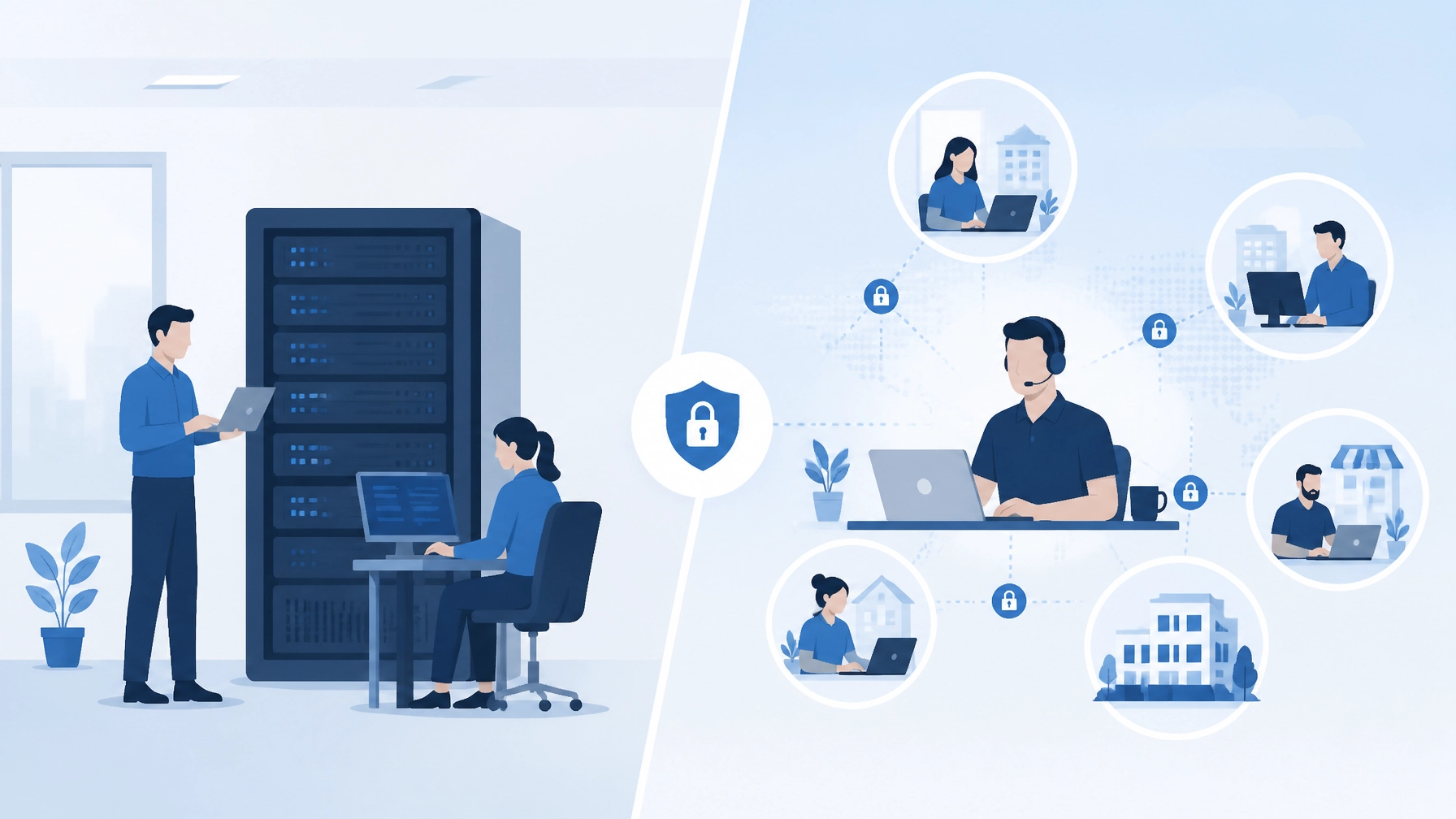
Choosing how to support our IT systems is a major business decision. We can hire an internal IT person, build a full team, work with an external provider, or combine both approaches.
There’s no single answer for every business. The right choice depends on our size, systems, budget, security needs and working hours.
This guide compares IT outsourcing with in-house IT support. It also explains when a hybrid approach may be the most practical option.
What’s the difference?
In-house IT
With in-house IT, we employ one or more people directly. They work within the business and support our systems, users and projects.
This can give us:
- Direct control over priorities
- Strong knowledge of our business
- Fast face-to-face support
- Close collaboration with other departments
- A team we can shape around our culture
However, we also take responsibility for salaries, recruitment, training, tools, holidays, sickness cover and staff retention.
Outsourced IT support
With outsourced IT, we use an external provider for some or all of our support. The provider may work remotely, visit our sites when needed, or provide both.
An outsourced IT team can support:
- Desktops and servers
- Networks and connectivity
- Cloud applications
- Cyber security
- Backups and updates
- Hardware and software
- IT projects
- Out-of-hours emergencies
We pay for an agreed service rather than employing the people who deliver it.
Cost: salary versus predictable monthly fees
Cost is often the first point we consider. It’s important to compare the full cost of each option, not just the salary or monthly fee.
A UK IT technician may earn around £35,000 to £55,000 a year, depending on experience and location. Employer National Insurance, pension contributions, recruitment, training, equipment and software can take the total cost to approximately £43,000 to £70,000 a year.
These figures are indicative. They’ll vary by role and region. The wider point is that one employee can represent a significant fixed cost.
Research published by Connection Technologies gives similar estimates and suggests that outsourced IT for a 30-user business may cost around £16,200 to £28,800 a year, depending on the service included.
A monthly outsourced IT fee may include access to several engineers, monitoring, security tools and extended-hours support. We should always check exactly what’s included before comparing prices.

| Area | In-house IT | Outsourced IT |
|---|---|---|
| Main cost | Salary and employer costs | Monthly service fee |
| Expertise | Depends on the person or team we hire | Access to several specialists |
| Holiday and sickness | We arrange cover | Usually covered by the provider |
| Out-of-hours support | Requires extra staff or an on-call plan | May be included as an option |
| Recruitment | Our responsibility | Provider’s responsibility |
| Scaling | We may need to hire again | Capacity can often scale with us |
| Tools and licences | We purchase and maintain them | Some may be included |
| On-site support | Immediately available if staff are present | Arranged when needed |
| Specialist projects | May require external help | Often available through the provider |
The cheapest option isn’t always the best option. We should compare the total cost over several years, along with service coverage and business risk.
When in-house IT may be the right choice
In-house IT can work well when IT is central to how our business operates.
It may suit us if:
- We have a large number of users
- Our systems are highly customised
- We need people on-site every day
- IT is part of our main product or service
- We need close control over internal projects
- We already have strong technical leadership
- We can afford more than one IT employee
An internal team can build detailed knowledge of our systems and working practices. It can also work closely with finance, operations, HR and senior management.
For businesses with complex internal applications or strict operational requirements, that close connection can be valuable.
There are still practical limits. One person can’t be an expert in networks, security, cloud platforms, servers, applications and hardware at the same time. We may still need external support for specialist projects, security reviews or major upgrades.
When outsourced IT support may be the better fit
Outsourced IT is often suitable for small and medium-sized businesses that need reliable support without building a large internal department.
It may fit us if:
- We have a small or growing team
- We want predictable monthly costs
- We need access to several areas of expertise
- We don’t want one employee to become a single point of failure
- We need support outside normal office hours
- We work across several sites
- We need stronger security and regular patching
- We’re planning a migration, upgrade or office move
- We want to scale without repeated recruitment
IT outsourcing can also reduce the pressure on business leaders. Instead of managing recruitment, training and technical tools, we can focus on service quality, security and business outcomes.
Remote-first support can resolve many issues quickly without waiting for an engineer to travel. For hardware, cabling or other physical problems, an on-site visit can still be arranged.
At Your IT Specialist, we explain how remote and out-of-hours IT support can help businesses that operate beyond a traditional 9-to-5 day.
The risks of outsourcing
Outsourcing isn’t automatically the right answer. We should consider the possible drawbacks.
We have less direct control
An external team may support several clients. We’ll need a clear process for prioritising work and escalating urgent issues.
A practical solution: agree response times, escalation routes and regular service reviews before work begins.
Some work may cost extra
Routine support may be covered by a monthly fee, while projects, hardware installation or major changes may be charged separately.
A practical solution: ask for a clear service description and request estimates for likely project work.
The provider needs time to learn our systems
A new provider won’t understand our environment immediately.
A practical solution: prepare documentation, access details, asset lists and key contacts during onboarding.
We depend on another business
Our IT provider becomes an important part of our business continuity plan.
A practical solution: check security practices, insurance, staff access controls, backup arrangements, contract terms and exit processes.
Good providers should welcome these questions. Clear answers are more useful than vague promises.
The hybrid model
We don’t have to choose between entirely internal or entirely external support.
A hybrid model might include:
- An internal IT manager who understands the business
- An outsourced helpdesk for day-to-day support
- External specialists for cyber security and infrastructure
- Out-of-hours cover from an external team
- Project support for upgrades, migrations and installations

This approach can give us internal ownership without requiring a large technical department. The internal person can focus on strategy, communication and business priorities. The external team can provide broader expertise and additional cover.
It can also help when an internal IT employee is away, leaves the business or needs support with an unfamiliar problem.
A simple decision checklist
Before choosing our support model, we can ask:
Business size
- How many users do we support today?
- How quickly are we growing?
- Will we open more sites or introduce remote working?
IT complexity
- Are our systems mostly standard applications?
- Do we rely on custom software or older equipment?
- Do we need specialist support for networks, servers or cloud systems?
Security
- Who manages updates and security alerts?
- How quickly would we respond to an incident?
- Do we need regular vulnerability assessments or policy advice?
Our cyber security services cover areas such as firewalls, patching, vulnerability assessments, log analysis and practical security advice.
Availability
- Do our systems need support in the evening or at weekends?
- Do staff work across different locations or time zones?
- What happens if the main IT contact is ill or on holiday?
Budget
- Are we comparing total employment costs?
- Would a predictable monthly fee help us plan?
- Are project costs and hardware costs clearly separated?
Relationship
- Does the provider offer impartial advice?
- Can we speak to the engineers supporting us?
- Are contract and exit terms straightforward?
- Will the provider work with our existing technology?
Our impartial view
For many smaller businesses, outsourced IT can provide wider expertise and better cover than one internal employee. It can also make costs easier to plan.
For larger or highly specialised organisations, in-house IT may offer valuable control and detailed business knowledge.
For many growing businesses, hybrid support offers a sensible middle ground.
The important point is that outsourcing should solve a real business need. We shouldn’t be pushed into replacing systems or buying services we don’t need. A provider should first understand our environment, goals and risks.
Your IT Specialist offers provider-agnostic advice, remote-first support and out-of-hours assistance. We can also help with hardware, software, networking, security and IT projects. For MSPs and communications providers, our white-label IT contract services provide extra technical capacity under their own brand.
The best IT support model is the one that gives us the right balance of control, expertise, availability and cost. Reviewing that balance now can help us build a more resilient IT plan for the years ahead.
